

Astaksantin – najmoćniji antioksidans

 7 MIN
7 MIN  ALMAGEA
  16.01.2024
7 MIN ALMAGEA 16.01.2024
Oxidative stress that leads to mitochondrial dysfunction represents an imbalance between excessive production of free radicals and the body's ability to neutralize reactive compounds. Oxygen atoms usually come in pairs, but when an oxygen atom is single, it is extremely unstable and causes the formation of reactive oxygen species (ROS), including highly reactive peroxides and superoxides, which damage cellular lipids and proteins causing disruption of cellular homeostasis. Disrupted homeostasis leads to inflammation and consequent DNA damage. This process is also thought to contribute to accelerated aging. Dodatno, oksidacijski stres se istovremeno smatra uzrokom i posljedicom mnogih životno ugrožavajućih stanja i bolesti poput dijabetesa, kardiovaskularnih i neurodegenerativnih bolesti.
Research shows that people who consume a diet with the highest content of carotenoids have the lowest incidence of morbidity and mortality from chronic diseases because carotenoids are effective "hunters" of free radicals and thereby reduce oxidative stress that causes cellular damage. Astaxanthin is a natural carotenoid whose chemical structure resembles beta-carotene, but it is considered a more powerful antioxidant than beta-carotene, lycopene, lutein and other members of their family.
Određena su istraživanja pokazala kako oralni unos već od 2 mg dnevno, tijekom 4 tjedna, rezultira značajnim smanjenjem endogenog oksidacijskog oštećenja DNA, za oko 40 %.
Astaxanthin is the strongest natural antioxidant from the group of carotenoids; 10 times stronger than beta-carotene and 500 times stronger than vitamin E. Although they have similar chemical structures, astaxanthin, unlike beta-carotene, has a keto and a hydroxyl group at each end of the molecule that contribute to its antioxidant power. Also, astaxanthin is topiv u mastima i može proći barijeru mozga i retine i tamo pružati zaštitni učinak while beta-carotene and lycopene cannot.

Glavna gradivna komponenta sive tvari mozga su masne kiseline koje su izrazito osjetljive na oštećenje uzrokovano djelovanjem slobodnih radikala (proces lipidne peroksidacije). Astaksantin ima sposobnost apsorpcije UVB zraka što je primijećeno na algi Haematococcus pluvialis which naturally protects itself from intense UV radiation by producing large amounts of astaxanthin, which serves as a protective factor. In addition to exceptional antioxidant capabilities, astaxanthin also has strong anti-inflammatory properties.
Astaxanthin exerts its powerful effect in several systems in the body:
The knowledge and evidence of action gathered so far support the fact that astaxanthin is a natural, practical and comprehensive strategy in the prevention, but also supportive therapy, of many conditions and diseases.
Author: Vitaminoteka nutritionist team
Literature:
1. Biswal, S. Oxidative stress and astaxanthin: The novel supernutrient carotenoid. Int J Health Allied Sci. 2014. 3(3): 147-153.
2. Chena, J., Kotani, K. Astaxanthin as a Potential Protector of Liver Function: A Review. J Clin Med Res. 2016;8(10):701-704.
3. Kishimoto Y, Yoshida H, Kondo K. Potential Anti-Atherosclerotic Properties of Astaxanthin. Mar Drugs. 2016 Feb 5;14(2).
4. Komatsu T, Sasaki S, Manabe Y, Hirata T, Sugawara T. Preventive effect of dietary astaxanthin on UVA-induced skin photoaging in hairless mice. PLoS One. 2017 Feb 7;12(2):e0171178.
5. Yoshihisa Y, Andoh T, Matsunaga K, Rehman MU, Maoka T, Shimizu T. Efficacy of Astaxanthin for the Treatment of Atopic Dermatitis in a Murine Model. PLoS One. 2016 Mar 29;11(3):e0152288.
6. Kim YK., Chyun JH.The Effects of Astaxanthin Supplements on Lipid Peroxidation and Antioxidant Status in Postmenopausal Women. Nutr Sci. 2004 7(1): 41-46.
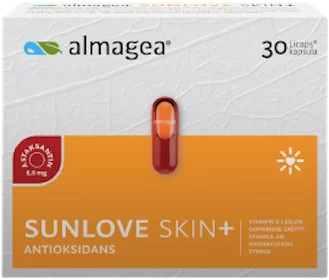
Skin care from the inside all year round and protection against oxidative stress.
23.98 €

Get to know us
Dietary supplements
Information
Let's connect
© 2024. Almagea d.o.o., Ulica Julija Knifera 4, 10 020 Zagreb
Fixed conversion rate: €1 = HRK 7.5345
kupuj brzo i sigurno 