


Beneficial effects of astaxanthin on brain health

 7 MIN
7 MIN  ALMAGEA
  16.01.2024
7 MIN ALMAGEA 16.01.2024
Due to the increase in life expectancy in almost all developed countries, more and more people are starting to worry about brain health, preservation of vision and cognitive functions, and there is a growing interest in preventive ways of preserving mental health in advanced age (1).
Oxidative stress is defined as a lack of balance between the appearance of reactive forms of oxygen and nitrogen, i.e. free radicals, and the ability of the organism to suppress their action with antioxidant protection systems (2). Reactive forms of oxygen and nitrogen lead to the creation of oxidative stress, which causes damage to various tissues. Since brain tissue has a high content of polyunsaturated fatty acids, it is particularly sensitive to the negative influence of free radicals (3).
Vitamin E plays a role in preserving cell membranes from free radical damage by fighting lipid peroxidation of cell membranes (2). Selenium, in synergy with vitamin E, also has an antioxidant effect, acting as an important intracellular antioxidant in preventing oxidative damage (4).
Karotenoid astaksantin u prirodi se može naći kod određenih biljaka, životinja i algi. Ovaj snažni antioksidans dobiva se iz mikroalgi vrste Haematococcus pluvialis.It is interesting due to its antioxidant, anti-inflammatory and cardioprotective properties, due to its protective effect on eye health, modulation of the immune system and neuroprotective activities (1).
It is known that astaxanthin, one of the strongest antioxidants in nature (up to 500 times stronger than vitamin E), has a beneficial effect on the skin, heart and joint pain. Namely, the latest research shows that astaxanthin also has a strong protective effect on the human brain because, due to its unique chemical structure, it simply passes through the blood-brain barrier (5). It has been shown that in this way astaxanthin can reduce depression and stress in healthy subjects, as well as improve memory in people with impaired cognitive functions (6).
Klinička studija koju su proveli Talbott i suradnici bila je usmjerena na različite parametre mentalnog zdravlja. U studiji je sudjelovalo 28 zdravih, aktivnih, odraslih ispitanika kojima nije dijagnosticirana depresija, u dobi od 26 do 63 godine. Tijekom 8 tjedana jedna skupina uzimala je astaksantin, dok je kontrolna skupina uzimala placebo. Dodatak prehrani sadržavao je ekstrakt mikroalgi vrste Haematococcus pluvialis koji sadrži 12 mg astaksantina te je kombiniran s uljem srednjelančanih masnih kiselina i malom količinom D-α tokoferola radi održavanja stabilnosti sastava kapsule (1). Znanstvenici su po završetku studije primijetili značajna poboljšanja u određenim parametrima mentalnog zdravlja, uključujući osjećaj depresije, umor i raspoloženje. Istraživači su izvijestili kako se:
Znanstvenici su do ovog zaključka došli koristeći rezultate studije prikupljene na zdravim ispitanicima pomoću upitnika o njihovom osjećaju depresije. Upitnik je sadržavao subjektivna pitanja o njihovim simptomima depresije koji se mogu javiti i kod osoba koje nemaju kliničku dijagnozu depresije. Autori studije navode kako je također uočeno poboljšanje ostalih važnih parametara mentalnog zdravlja poput napetosti, bijesa i konfuzije (1).
Nadalje, Sekikawa i suradnici su u svom istraživanju ispitivali kognitivno zdravlje sudionika u randomiziranoj, dvostruko slijepoj studiji kontroliranoj placebom. Svi ispitanici bili su zdrave odrasle osobe s blagom zaboravnosti te su bili podijeljeni u dvije skupine. Jedna je skupina uzimala 9 mg ekstrakta astaksantina dobivenog iz mikroalgi vrste Haematococcus pluvialis, while another took safflower oil in tablet form as a placebo (6). After 12 weeks of taking astaxanthin, there was a statistically significant improvement compared to the placebo group after tests of cognitive function and memory. Verbal and complex memory improved significantly, as tested by a computer system used to monitor and measure brain function. Complex memory improved by 22.3%, while improvement in reasoning increased by as much as 48.2% and subjective symptoms improved by 25%, after 12 weeks of taking astaxanthin (6).
Literature:
1. Talbott, S., Hantla, D., Capelli, B., Ding, L., Li, Y., Artaria, C. (2019) Astaxanthin Supplementation Reduces Depression and Fatigue in Healthy Subjects. EC Nutrition. 14(3), 239-246.
2. Pisoschi, A. M., Pop, A. (2015)The role of antioxidants in the chemistry of oxidative stress: A review. Eur. J. Med. Chem.97, 55–74.
3. Uttara, B., Singh, A., Zamboni, P., Mahajan, R. (2009) Oxidative Stress and Neurodegenerative Diseases: A Review of Upstream and Downstream Antioxidant Therapeutic Options. Curr. Neuropharmacol, 7(1), 65–74.
4.Wang, N., Tan, H.-Y., Li, S., Xu, Y., Guo, W., Feng, Y. (2017) Supplementation of Micronutrient Selenium in Metabolic Diseases: Its Role as an Antioxidant. Oxid. Honey. Cell. Longev.2017, 1–13.
5. Galasso, C., Orefice, I., Pellone, P., Cirino, P., Miele, R., Ianora, A., Brunet, C., Sansone, C. (2018) On the Neuroprotective Role of Astaxanthin: New Perspectives? Mar.Drugs.16(8), 247.
6. SekikawaT., Kizawa Y., Li Y., Takara T. (2019) Cognitive Function Improvement with Astaxanthin Intake: A Randomized, Double-Blind, Placebo-Controlled Study. Pharmacometric. 97 (1/2), 1-13.
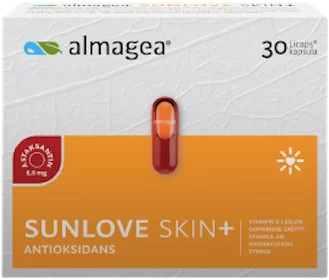
Skin care from the inside all year round and protection against oxidative stress.
23.98 €

Get to know us
Dietary supplements
Information
Let's connect
© 2024. Almagea d.o.o., Ulica Julija Knifera 4, 10 020 Zagreb
Fixed conversion rate: €1 = HRK 7.5345
kupuj brzo i sigurno 