


New insights into the effects of astaxanthin on skin health

 5 MIN
5 MIN  ALMAGEA
  16.01.2024
5 MIN ALMAGEA 16.01.2024
Astaksantin je jedan od najpoznatijih biljnih pigmenata iz skupine karotenoida kojeg stvaraju biljke i mikroalge, a zanimljivo je da crvena boja ljuskara, poput škampa, rakova i jastoga, potječe upravo od ovog pigmenta. Najbolji prirodni izvor astaksantina, koji u svojim stanicama sadrži više od 80 % ovoga pigmenta te se zato i koristi u svrhu komercijalne proizvodnje, je mikroalga Haematococcus pluvialis.
Astaxanthin effectively protects cell membranes, and its basic property is a strong antioxidant activity that has a potentially beneficial effect on numerous health problems. Scientific literature speaks in favor of astaxanthin and emphasizes its protective effect on the prevention of damage caused by UV radiation, anti-inflammatory and strong antioxidant activity.
Atopic dermatitis is a chronic inflammatory skin disease, and astaxanthin, as a carotenoid with anti-inflammatory effects, works favorably in this condition by reducing the production of inflammatory mediators. Research has shown that astaxanthin suppresses the production of inflammatory mediators such as TNF-α, prostaglandins, leukotrienes and interleukins.
Skupina karotenoida, a osobito astaksantin, pokazuju i antialergijsko djelovanje kod alergija na sunce. Naime, kod alergija na sunce imunološki sustav neuobičajeno reagira na promjene koje se događaju na koži izlaganjem suncu. Snažan antioksidacijski učinak astaksantina, očituje se i smanjenjem negativnog djelovanja UV zraka na imunološku funkcionalnost kože što it also gives this pigment an effect against allergic reactions on the skin.
In research, astaxanthin has also been shown to be useful in protecting against UV radiation. Namely, in research on animals it was discovered that astaxanthin accumulates in the skin and can prevent the harmful effects of UV radiation on the metabolism of filaggrin, a protein that maintains the moisture and acidic pH of the skin, and on peeling of the skin. Oral intake of astaxanthin protects the skin from signs of photoaging such as the appearance of wrinkles and a damaged skin barrier.
Studije novijeg datuma daju uvid u neke nove spoznaje o zaštitnom djelovanju astaksantina na kožu kod UV-zračenja. Tako je cilj dvostruko slijepog placebo kontroliranog istraživanja objavljenog u časopisu Nutrients bio utvrditi utjecaj uzimanja astaksantina u obliku dodatka prehrani na stanje kože izložene spomenutoj vrsti zračenja. U ovom japanskom istraživanju koje je trajalo 10 tjedana sudjelovalo je 23 ispitanika dobi između 30 i 59 godina, a koji su bili raspoređeni u dvije skupine. Prva je skupina dobivala kapsule astaksantina u dozi od 4 mg, dok je druga skupina primala placebo. Znanstvenici su promatrali sljedeće parametre – minimalnu eritemsku dozu (MED, eng. minimum erythrema dose), i.e. the amount of UV-radiation necessary for the appearance of skin redness, and changes in humidity and transdermal water loss caused by UV-radiation at the beginning and after 9 weeks of supplementation. Furthermore, using a visual analogue scale, the subjects also gave a subjective opinion about the condition of their skin.
The results showed that the test subjects in the astaxanthin group, compared to the placebo group, had to be irradiated with a much larger amount of UV-radiation in order to observe the appearance of redness. The same subjects also noted an improvement in the texture of the non-irradiated skin area. In addition to the positive effects of astaxanthin on skin health, which have been confirmed by science, this is the first study that also proved the effect of taking astaxanthin on the minimum erythema dose and maintaining the moisture of the irradiated skin area.
Author: Vitaminoteka nutritionist team
Literature:
1. Biswal, S. Oxidative stress and astaxanthin: The novel supernutrient carotenoid. Int J Health Allied Sci. 2014. 3(3): 147-153.
2. Chena, J., Kotani, K. Astaxanthin as a Potential Protector of Liver Function: A Review. J Clin Med Res. 2016;8(10):701-704.
3. Davinelli S, Nielsen ME, Scapagnini G. Astaxanthin in Skin Health, Repair, and Disease: A Comprehensive Review. Nutrients. 2018;10(4). pii: E522.
4. Ito N, Seki S, Ueda F. The Protective Role of Astaxanthin for UV-Induced Skin Deterioration in Healthy People-A Randomized, Double-Blind, Placebo-Controlled Trial. Nutrients 2018; 10(7). pii: E817. doi: 10.3390/nu10070817.
5. Kishimoto Y, Yoshida H, Kondo K. Potential Anti-Atherosclerotic Properties of Astaxanthin. Mar Drugs. 2016 Feb 5;14(2).
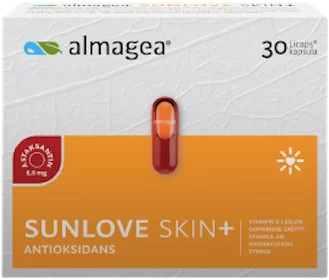
Skin care from the inside all year round and protection against oxidative stress.
23.98 €


Get to know us
Dietary supplements
Information
Let's connect
© 2024. Almagea d.o.o., Ulica Julija Knifera 4, 10 020 Zagreb
Fixed conversion rate: €1 = HRK 7.5345
kupuj brzo i sigurno 