Krill oil and antioxidants as supportive therapy for vitiligo

 7 MIN
7 MIN  ALMAGEA
  09.01.2024
7 MIN ALMAGEA 09.01.2024
Vitiligo je poremećaj pigmentacije kože koji pogađa otprilike 1 do 4 % svjetske populacije. U više od polovine slučajeva bolest se dijagnosticira do dobi od 20 godina, a jednako je zastupljena među muškarcima i ženama kao i različitim rasnim skupinama. Uzroci uništavanja pigmentnih stanica melanocita i pojave bijelih mrlja na koži su za sada nepoznati, međutim, postoji nekoliko teorija koje nastoje riješiti misterij ove bolesti velikog utjecaja na psihološko stanje i kvalitetu života oboljelih.
The main theories about the pathogenesis of vitiligo are: autoimmune, neural, self-destruction hypothesis and biochemical hypothesis. The hypothesis according to which vitiligo belongs to the group of autoimmune diseases has the greatest support because it is known that vitiligo sufferers often suffer from several other autoimmune diseases.The immunological reaction in the skin is marked by the appearance of inflammation.
The self-destruction hypothesis states that in melanocytes there is an error in the operation of the protective mechanisms that are normally responsible for the removal of harmful melanin precursors. It is precisely because of this error that the accumulation of toxic indole derivatives and free radicals occurs.
According to the fourth, biochemical hypothesis, in the skin of patients there is an excessive production of compounds that lead to the accumulation of reactive oxygen compounds and the deterioration of melanocytes. This theory is confirmed by studies that recorded a high level of hydrogen peroxide in the skin of patients. Given that all the above theories about the cause of vitiligo are supported by certain evidence, it can be assumed that several different pathophysiological processes take place in the background of vitiligo.
Today, it is considered that inflammatory processes in the body significantly contribute to the development of numerous chronic diseases.
The mechanism of action involves a change in the transcription of key inflammatory genes. In addition, omega-3 fatty acids compete with omega-6 fatty acids for the same enzymes, thus synthesizing fewer pro-inflammatory eicosanoids. Omega-3 fatty acids have another advantage, which is that they can be converted into anti-inflammatory molecules such as resolvins, protectins and endocannabinoids.
Sitni morski račić latinskog naziva Euphausia superba već više od desetljeća intrigira znanstvenu zajednicu zbog sadržaja omega-3 masnih kiselina koje su u ulju krila dostupne u posebnom obliku. U ulju krila, glavnina EPA i DHA vezana je na fosfolipide, posebice fosfatidil kolin. Tako vezane masne kiseline učinkovito se prenose po tijelu i ugrađuju u stanične membrane. Kada EPA i DHA postanu dijelom stanične membrane, mogu utjecati na fluidnost, signalne i metaboličke procese u stanici.
The chemical form of omega-3 fatty acids is also suitable when it comes to absorption from the digestive system, because phospholipids of fatty acids do not require bile salts for digestion - they spontaneously form micelles, are soluble in water and thus have easier absorption.
Several studies have compared the effects of krill oil and conventional fish oil preparations, and the results systematically indicate better bioavailability of krill oil.When comparing the level of EPA and DHA in these preparations, it is concluded that almost twice the lower dose of EPA+DHA from krill oil is needed compared to omega-3 fatty acids from fish oil for the same or better effect.
In people diagnosed with vitiligo, an oxidative imbalance has been recorded both in the skin and in the body. The reason for this is either excessive production of free radicals or insufficient production of antioxidants that would neutralize them.
Antioxidants are enzymes that the body itself produces and non-enzymatic molecules that either the body produces or we ingest through the diet, such as vitamin C, vitamin E and alpha-lipoic acid, as well as selenium.
A study published in 2009.in the British Journal of Dermatology discovered that the enzyme methionine sulfoxide reductase (MSR) is present in lower amounts and is less active in patients with vitiligo. Lack of this enzyme makes melanocytes more susceptible to the harmful effects of oxidative stress and consequently leads to greater cell death. Therefore, taking antioxidants in the form of a dietary supplement may be helpful. Several studies have shown that antioxidants are an effective and affordable supportive therapy and that they are well tolerated.
The beneficial effects of krill oil mostly come from the polyunsaturated fatty acids EPA and DHA, however, the oil also contains vitamins A and E, the red pigment astaxanthin, a special type of flavonoid, and phosphatidyl-choline. Such a natural mixture of substances makes the oil stable, persistent and, above all, bioavailable. Due to the additional content of vitamins with antioxidant activity and the pigment astaxanthin, krill oil achieves synergistic antioxidant activity along with all the well-known effects of omega-3 fatty acids.
Authors: Mirja Jošić, B.Sc., Prof. Ph.D. Darija Vranesic Bender
Literature:
1. Alikhan, A., Felsten, L., Daly, M., Petronic-Rosic, V. Vitiligo: A comprehensive overview. Part I.Introduction, epidemiology, quality of life, diagnosis, differential diagnosis, associations, histopathology, etiology, and work-up. J Am Acad Dermatol 2011. 65(3): 473–491.
2. Alikhan, A., Felsten, L., Daly, M., Petronic-Rosic, V. Vitiligo: A comprehensive overview. Part II: Treatment options and approach to treatment. J Am Acad Dermatol 2011;65:493-514.
3. Calder PC. Polyunsaturated fatty acids and inflammatory processes: New twists in an old tale. Biochemistry. 2009;91:791–795.
4. Calder PC. Dietary modification of inflammation with lipids. Proc NutrSoc. 2002;61:345–358.
5. Serhan CN, Gotlinger K, Hong S, Arita M. Resolvins, docosatrienes, and neuroprotectins, novel omega-3-derived mediators, and their aspirin-triggered endogenous epimers: an overview of their protective roles in catabasis.Prostaglandins Other Lipid Mediat. 2004;73:155–172.
6. Ramprasath, V.R., Eyal, I., Zchut, S., Jones, P.J.H. Enhanced increase of omega – 3 index in healthy individuals with response to 4-week n-3 fatty acid supplementation from krill oil versus fish oil. Lipids Health Dis. 2013 12:178
7. Ulven SM, Kirkhus B, Lamglait A, Basu S, Elind E, Haider T, Berge K, Vik H, Pedersen JI: Metabolic Effects of Krill Oil are Essentially Similar to Those of Fish Oil but at Lower Dose of EPA and DHA, in Healthy Volunteers. Lipids 2011, 46(1):37-46.
8. Winther B, Hoem N, Berge K, Reubsaet L: Elucidation of Phosphatidylcholine Composition in Krill Oil Extracted from Euphausia superba. Lipids 2010, 46(1):25-36.
9. Picardo, M., Taieb, A. Vitiligo. Springer-Verlag Berlin Heudelberg, 2010.
10. Gao, T. et al. Decreased methionine sulphoxide reductase A expression renders melanocytes more sensitive to oxidative stress: a possible cause for melanocyte loss in vitiligo. Br J Dermatol 2009; 161(3):504-9
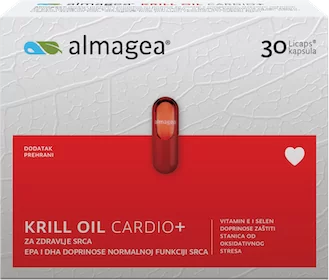
Omega-3 fatty acids are necessary for the normal functioning of the whole organism.
23.97 €


Get to know us
Dietary supplements
Information
Let's connect
© 2024. Almagea d.o.o., Ulica Julija Knifera 4, 10 020 Zagreb
Fixed conversion rate: €1 = HRK 7.5345
kupuj brzo i sigurno