


Kurkumin za crijeva – kako kurkumin liječi upale i bolesti
 LIFESTYLE
  8 MIN
8 MIN  ALMAGEA
  06.10.2022
LIFESTYLE 8 MIN ALMAGEA 06.10.2022
Turmeric (Curcuma longa) je začin jarko žute boje koji se dobiva iz podzemnog stabla (rizoma) istoimene biljke karakteristične za područje Indije i jugoistočne Azije. Aromatičnog je gorkasto-slatkog okusa i blagog mirisa koji podsjeća na đumbir (s kojim je u srodstvu), a koristi se kao samostalan začin u pripremi jela, ali i kao jedan od sastojaka curry praha.
Karakterističnu žutu boju kurkuma duguje polifenolu kurkuminu, biološki aktivnom polifenolu iz skupine kurkuminoida kojem se pripisuje snažno protuupalno i antioksidativno djelovanje.
Kurkumin posjeduje široki spektar bioloških učinaka, poglavito protuupalno, antioksidativno, imunomodulatorno, pro-apoptotsko, antiproliferatorno, antimutageno, antikoagulantno, antibakterijsko, antimikotičko, antivirusno, hipotenzivno i hipokolesterolemičko djelovanje. Djelotvoran je za mnoge bolesti, zbog čega je curcumin for the gut koja su upaljena odličan lijek.
Budući da je kurkumin bezopasan prirodni aktivni biološki spoj koji posjeduje snažno protuupalno djelovanje, ima potencijal primjene u prevenciji i suportivnoj terapiji upalnih bolesti crijeva. Tome svjedoče brojna znanstvena istraživanja, od onih provedenih u laboratoriju i na životinjama, do kliničkih studija provedenih na ljudima. Djelovanje kurkumina usmjereno je na brojne stanične mete povezane sa smanjenjem progresije bolesti (npr. NF-κB, JAK/STAT, MAPK, TNF-α, IFN-γ, IL-6, PPARγ, i TRPV1).
During the last fifteen years, scientific interest in the role of curcumin as an auxiliary medicinal substance in inflammatory bowel diseases has grown significantly. Numerous placebo-controlled randomized clinical studies have shown that curcumin for the intestines is safe and effective in the treatment of their diseases.
Prva multicentrična studija koja je imala obećavajuće rezultate kod primjene kurkumina u oboljelih od ulceroznog kolitisa objavljena je 2006. godine. U različitim kliničkim centrima prikupljeno je 89 bolesnika s ulceroznim kolitisom od kojih je polovica primala 1 g kurkumina dva puta dnevno uz terapiju sulfasalazinom ili mesalaminom. Druga polovica ispitanika uz osnovnu terapiju je uzimala placebo. Studija je trajala 6 mjeseci, a od inicijalnog broja ispitanika do kraja je ostalo 82 ispitanika.
The results showed that the relapse rate was significantly higher in the placebo group (20.5% (8/39)) compared to the curcumin group (4.7% (2/43)).
These observations were accompanied by an objective reduction in the clinical activity of the disease and endoscopic indices.
Another double-blind controlled clinical study showed that the administration of curcumin is useful in inducing remission in UC patients on aminosalicylate therapy. The study involved 50 patients with mild to moderate UC on 5-ASA therapy who were divided into two groups. One group received 3 g of curcumin and the other a placebo for four weeks.
After this intervention, in the group receiving curcumin:
These significant results demonstrate the potential for curcumin to be beneficial to the gut without adverse side effects in patients with mild to moderate ulcerative colitis.
U još jednoj randomiziranoj kliničkoj studiji sudjelovalo je 70 bolesnika s blagim do umjerenim UC koji su svakodnevno uzimali 1500 mg kurkumina ili placebo tijekom osam tjedana. Rezultati su pokazali kako je indeks kliničke aktivnosti (eng. Clinical Activity Index, CAI) bio značajno veći u skupini koja je uzimala kurkumin, u odnosu na placebo skupinu. Osim toga, uspoređujući s kontrolnom skupinom, uzimanje kurkumina utjecalo je na značajno smanjenje koncentracije C – reaktivnog proteina visoke osjetljivosti (hsCRP) te stopu sedimentacije eritrocita, ali i općenito na poboljšanje kvalitete života bolesnika s ulceroznim kolitisom.
Banerjee et al investigated the safety of use and the effect of a more bioavailable formulation of curcumin on reducing the clinical and endoscopic picture of ulcerative colitis. 69 patients with mild or moderate symptoms of the disease who received more biologically available curcumin (n=34) or placebo (n=35) participated in the study. After six weeks of taking curcumin, clinical remission was recorded in 44.1% (15/34) of subjects in the group receiving curcumin, while endoscopic remission was recorded in 35.3% (14/34) of subjects. For comparison, not a single case of disease remission was recorded in the placebo group. Therefore, based on this, it can be stated that curcumin for the intestines, i.e. its inflammations and diseases, is convincingly effective.
Likewise, the clinical response of subjects in the curcumin group was significantly higher (18/34, 52.9%) than in the placebo group (5/35, 14.3%). Three months after the start of the study, the rates of endoscopic remission, clinical response and clinical remission were 55.9% (19/34), 58.8% (20/34) and 44% (16/34) in the group receiving more bioavailable curcumin, while in the placebo group the rates were 5.7% (2/35), 28.6% (10/35), 5.7%, respectively. (2/35). Furthermore, 95% and 84% of the subjects who took the more bioactive curcumin maintained a state of clinical remission after six and 12 months, respectively. The authors of the study came to the conclusion that a more biologically available formulation of curcumin is a safe option that does not cause unwanted side effects.
Kurkumin je istraživan i u oboljelih od Crohn's disease, u kombinaciji s anti TNF-alfa terapijom (infliksimab) te je pokazano kako je u bolesnika na kombiniranoj terapiji kurkuminom i biološkom terapijom zabilježen niži indeks aktivnosti bolesti (eng. Crohn’s Disease Activity Index, CDAI).
In a small pilot study designed by Holt et al., the efficacy of curcumin was examined in five patients with CD. Subjects were given 360 mg of curcumin three times a day during the first month and then four times a day during the second month of the trial. Out of five subjects, four of them improved their condition, and the positive effect of curcumin was manifested in a decrease in the CD activity index, with a mean value of 55%, as well as in the erythrocyte sedimentation rate, with a mean decrease of 10 mm/h.
The role of vitamin D in reducing inflammation is well researched. Therefore, vitamin D is often researched and used in patients with inflammatory bowel diseases, because a low concentration of vitamin D in the blood is associated with elevated inflammatory markers and clinical activity of the disease. Low blood vitamin D concentration correlates with elevated calprotectin values in UC and CD patients and with higher CRP values in UC patients.
Nadalje, nedostatak vitamina D povezan je s većom aktivnosti bolesti, većom šansom za relaps i hospitalizaciju te potrebom uvođenja terapije glukokortikoidima. Stoga je uputno provjeravati koncentraciju vitamina D u krvi oboljelih od upalnih bolesti crijeva te primjenjivati odgovarajuće doze vitamina D3 kako bi se postigla i održala optimalna koncentracija vitamina D u krvi.
Smatra se kako kurkumin i vitamin D imaju sinergijski učinak u zaštiti probavnog sustava. Naime, još 2010. godine uočeno je kako se kurkumin može vezati na receptore vitamina D na modelu stanica karcinoma kolona i tako imati kemopreventivno djelovanje.
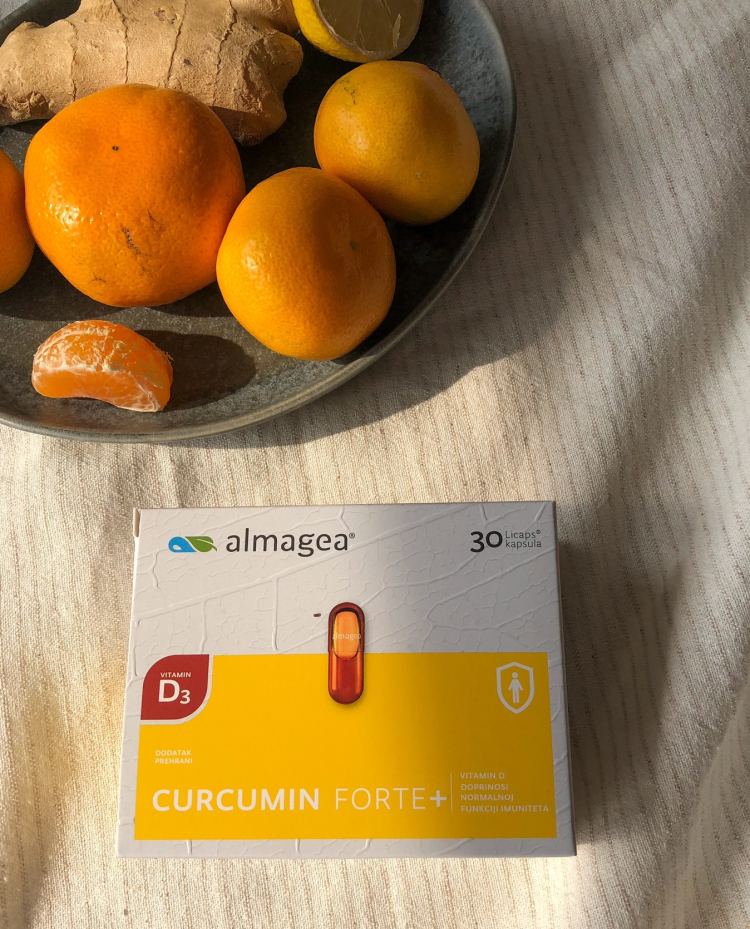
Curcumin for the gut u kombinaciji s vitaminom D3 korisni su lijekovi uz osnovnu terapiju upalne bolesti crijeva ili kao dodatak prehrani u razdobljima remisije.
Banerjee, R.; Pal, P.; Penmetsa, A.; Kathi, P.; Girish, G.; Goren, I.; Reddy, D.N. Novel Bioenhanced Curcumin With Mesalamine for Induction of Clinical and Endoscopic Remission in Mild-to-Moderate Ulcerative Colitis: A Randomized Double-Blind Placebo-controlled Pilot Study. J. Clin. Gastroenterol. in 2020
Bartik L, Whitfield GK, Kaczmarska M, Lowmiller CL, Moffet EW, Furmick JK, Hernandez Z, Haussler CA, Haussler MR, Jurutka PW. Curcumin: a novel nutritionally derived ligand of the vitamin D receptor with implications for colon cancer chemoprevention. J Nutr Biochem. 2010;21(12):1153-61.
Bommelaer, G.; Laharie, D.; Nancey, S.; Hebuterne, X.; Roblin, X.; Nachury, M.; Peyrin-Biroulet, L.; Fumery, M.; Richard, D.; Pereira, B. Oral curcumin no more effective than placebo in preventing recurrence of Crohn's disease after surgery in a randomized controlled trial. Clin. Gastroenterol. Hepatol. 2020, 18, 1553–1560.e1.
Hanai, H.; Iida, T.; Takeuchi, K.; Watanabe, F.; Maruyama, Y.; Andoh, A.; Tsujikawa, T.; Fujiyama, Y.; Mitsuyama, K.; Sata, M. Curcumin maintenance therapy for ulcerative colitis: Randomized, multicenter, double-blind, placebo-controlled trial. Clin.
Gastroenterol. Hepatol. 2006, 4, 1502–1506
Holt, P.R.; Katz, S.; Kirshoff, R. Curcumin therapy in inflammatory bowel disease: A pilot study. Dig. Dis. Sci. 2005, 50, 2191–2193.
Jadhav P, Jiang Y, Jarr K, Layton C, Ashouri JF, Sinha SR. Efficacy of Dietary Supplements in Inflammatory Bowel Disease and Related Autoimmune Diseases. Nutrients. 2020;12(7):2156.
Lang, A.; Salomon, N.; Wu, J.C.; Kopylov, U.; Lahat, A.; Har-Noy, O.; Ching, J.Y.; Cheong, P.K.; Avidan, B.; Gamus, D. Curcumin in combination with mesalamine induces remission in patients with mild-to-moderate ulcerative colitis in a randomized controlled trial
trial. Clin. Gastroenterol. Hepatol. 2015, 13, 1444–1449.e1.
Peterson, C.T.; Vaughn, A.R.; Sharma, V.; Chopra, D.; Mills, P.J.; Peterson, S.N.; Sivamani, R.K. Effects of Turmeric and Curcumin Dietary Supplementation on Human Gut Microbiota: A Double-Blind, Randomized, Placebo-Controlled Pilot Study. J. Evid. Based Integr. Honey. 2018, 23
Sadeghi, N.; Mansoori, A.; Shayesteh, A.; Hashemi, S.J. The effect of curcumin supplementation on clinical outcomes and inflammatory markers in patients with ulcerative colitis. Phytother. Crisp. 2020, 34, 1123–1133.
Sugimoto, K.; Ikeya, K.; Bamba, S.; Andoh, A.; Yamasaki, H.; Mitsuyama, K.; Nasuno, M.; Tanaka, H.; Matsuura, A.; Kato, M. Highly bioavailable curcumin derivative ameliorates Crohn's disease symptoms: A randomized, double-blind, multicenter study. J. Crohn's Colitis 2020, 14, 1693–1701.

Maintaining the body's defense resistance with the power of curcumin and vitamin D.
22.47 €


Get to know us
Dietary supplements
Information
Let's connect
© 2024. Almagea d.o.o., Ulica Julija Knifera 4, 10 020 Zagreb
Fixed conversion rate: €1 = HRK 7.5345
kupuj brzo i sigurno 